
Areas with the Highest Office Leasing Demand in Hanoi in 2026
Hanoi’s commercial office real estate market in 2026 is showing clear differences in leasing demand across geographic areas. Driven by foreign direct investment (FDI), the expansion of global technology service centres (offshoring), and progress in urban transport infrastructure, including Metro lines and Ring Roads 2.5 and 3, the capital’s office map continues to develop in a more decentralised, multi-polar direction.
Alongside the traditional core central business district (CBD), which retains its symbolic position, decentralisation towards western and northern areas is gaining momentum. Below is an in-depth analysis of the Hanoi locations with the highest office absorption rates and leasing demand in 2026.
Overview of Office Demand Distribution in Hanoi
Office leasing demand in Hanoi in 2026 is led by three core occupier groups: information technology and software companies, financial, banking and insurance institutions, and businesses in manufacturing, trade and services.
This shift in demand is reflected in three key trends:
Large-scale space requirements (Mega Deals): International occupiers prioritise buildings with large floor plates, from 1,000m2 to more than 2,000m2 per floor, to optimise uninterrupted workspace layouts.
Green building standards (ESG & Green Buildings): Demand is strongly concentrated in office projects certified by LEED, WELL or BCA Green Mark.
Optimised transport connectivity: Occupiers prioritise areas near urban rail stations, including Metro Line 2A Cat Linh – Ha Dong and Metro Line 3 Nhon – Hanoi Station, as well as radial transport corridors to make commuting more convenient for employees.
Cau Giay – Hanoi’s Technology Hub and Largest Office Demand Centre
Cau Giay District continues to hold the leading position in both the number of leasing transactions and the density of businesses in Hanoi.
Key office corridors: The Duy Tan IT cluster, Tran Thai Tong, Thanh Thai, Xuan Thuy, Cau Giay, and the Trung Kinh – Tran Duy Hung corridor.
Supply and rental characteristics:
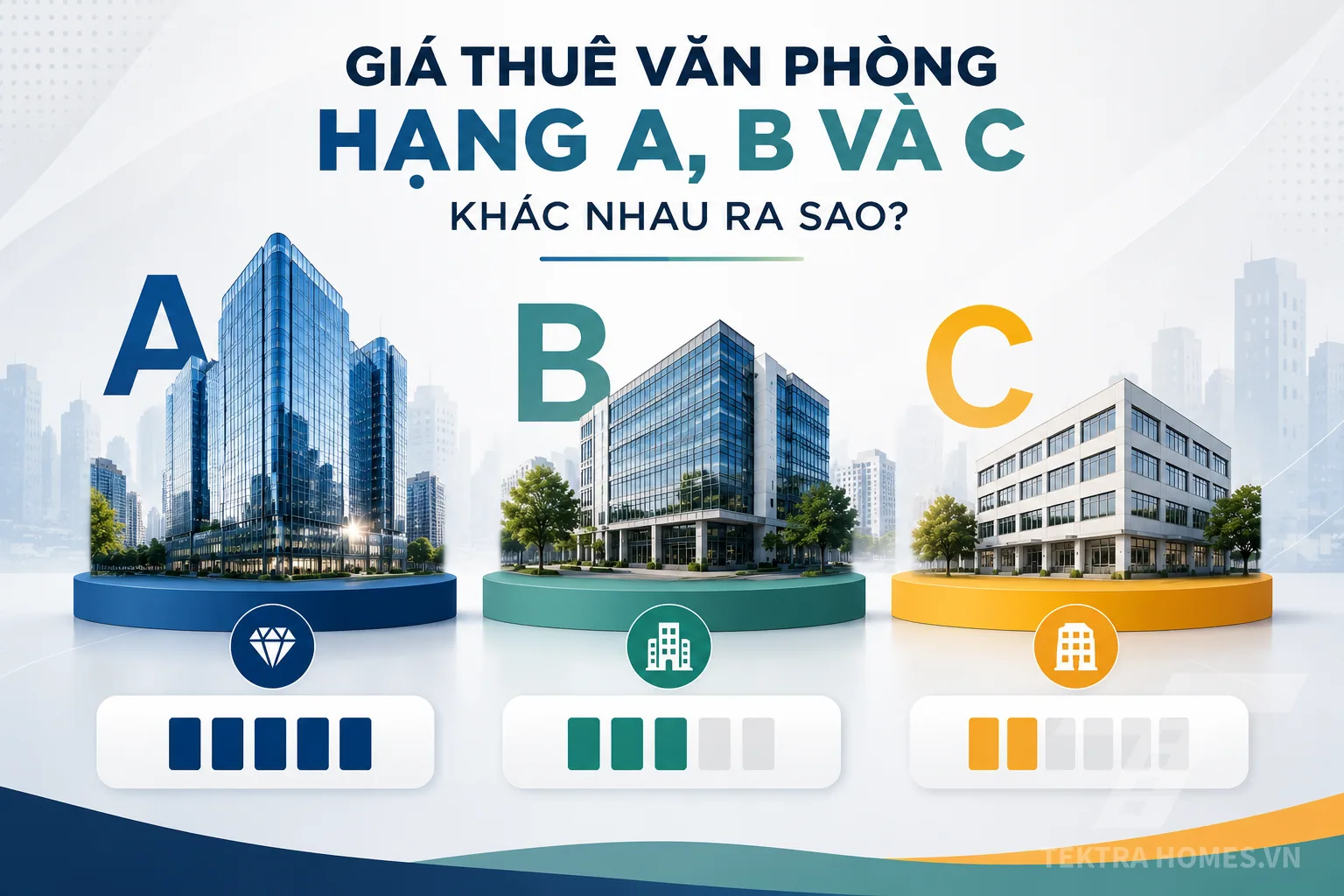
Offers abundant office stock, ranging from modern Grade A and Grade B towers to hundreds of Grade C buildings and commercial townhouses.
Average gross rents: USD 14 – 26/m2/month for Grade B and USD 27 – 34/m2/month for Grade A.
Key demand drivers:
Cau Giay is a hub for information technology, software, fintech, logistics and e-commerce businesses.
The area is home to leading technical universities, providing a large pool of young talent, while also offering extensive amenities, dining options and support services at reasonable costs.
Nam Tu Liem and My Dinh – A Focal Point for New-Generation Grade A Towers
The My Dinh area and Nam Tu Liem District are leading destinations for multinational corporations and companies requiring large, contiguous floor plates.
Key office corridors: Pham Hung Boulevard, Me Tri Street, Le Duc Tho Street, Le Quang Dao Street, and the service road along Thang Long Boulevard.
Supply and rental characteristics:
The area is concentrated with international-standard Grade A office towers featuring large floor plates of 1,200m2 to 2,500m2, high ceilings, raised floors and large-scale basement parking.
Average gross rents: USD 20 – 33/m2/month for premium Grade A/B space.
Key demand drivers:
Its well-planned road network provides direct connections to the elevated Ring Road 3, Noi Bai International Airport and satellite industrial areas in Bac Ninh, Vinh Phuc and Hai Phong.
The area hosts a sizeable community of Korean and Japanese businesses, as well as international R&D centres employing thousands of staff.
Ba Dinh and Dong Da – A Link Between Diplomacy, Finance and Traditional Commerce
The inner-city districts of Ba Dinh and Dong Da serve as a strategic bridge between the historic centre of Hoan Kiem and the new western economic centre.
Key office corridors: Lieu Giai, Kim Ma, Dao Tan, Nguyen Chi Thanh, Lang Ha, Thai Ha and Huynh Thuc Khang.
Supply and rental characteristics:
The area has numerous Grade A and Grade B office buildings with stable occupancy rates above 90%.
Average gross rents: USD 18 – 30/m2/month for Grade B and USD 32 – 42/m2/month for Grade A.
Key demand drivers:
It is home to major embassies, including those of Japan and Australia, international financial institutions, commercial banks and diplomatic representative offices.
The area benefits directly from Metro Line 3, including elevated and underground sections, enabling faster travel between the western area and the city centre.
West Lake West and Starlake – A New Growth Pole for R&D Centres and Corporate Headquarters
The West Lake West urban area (Starlake) and Vo Chi Cong Boulevard are emerging as a new model administrative and commercial centre for Hanoi.
Key office corridors: Vo Chi Cong Boulevard, the central Starlake area, the extended Nguyen Van Huyen Road and Hoang Quoc Viet Street.
Supply and rental characteristics:
All new supply is developed to international green standards, including LEED Gold/Platinum, and integrates retail amenities, five-star hotels and advanced research facilities.
Average gross rents: USD 25 – 38/m2/month.
Key demand drivers:
Direct access to Noi Bai International Airport in just 15 – 20 minutes via Nhat Tan Bridge.
A strategic destination for global technology corporations establishing research and development (R&D) centres, as well as diplomatic agencies and government ministries relocating in line with the overall master plan.
Hoan Kiem – Strengthening Brand Positioning for Financial Institutions and Investment Funds
Hoan Kiem District, the core CBD, maintains particular appeal for businesses that place a high value on prestige and international brand image.
Key office corridors: Ly Thuong Kiet, Hai Ba Trung, Ngo Quyen, Phan Chu Trinh and Trang Tien.
Supply and rental characteristics:
Land is scarce, new supply is almost nonexistent, and vacancy remains very low at below 5%.
The market’s highest average gross rents: USD 38 – 55+/m2/month.
Key demand drivers:
The district is concentrated with international investment funds, foreign banks, prestigious law firms and high-end service corporations.
Locating a headquarters in the heart of the capital reinforces credibility and a well-established brand position.
Comparison of Key Office Leasing Areas in Hanoi
Area | Key segment | Average gross rent | Typical occupiers | Key infrastructure advantage |
Cau Giay | Grade B, C & shophouses | USD 14 – 28/m2 | IT, fintech, logistics, SMEs | Diverse supply and extensive dining options |
Nam Tu Liem / My Dinh | International-standard Grade A and B | USD 18 – 33/m2 | FDI corporations, offshoring companies, Korean businesses | Large floor plates (>1,500m2), Ring Road 3 connectivity |
Ba Dinh / Dong Da | Premium Grade A and B | USD 20 – 40/m2 | Embassies, banks, Japanese businesses | Commercial hub near Metro Line 3 |
West Lake West (Starlake) | ESG-compliant green Grade A | USD 25 – 38/m2 | R&D centres, major technology corporations | 15 minutes to Noi Bai Airport, integrated master planning |
Hoan Kiem (CBD) | Iconic premium Grade A | USD 38 – 55+/m2 | Investment funds, international banks, law firms | Centre of influence and top-tier brand positioning |
Criteria for Selecting the Optimal Office Location
To select the most suitable headquarters location in 2026, businesses should consider four core criteria:
Alignment with business sector: Technology and software companies should prioritise Cau Giay or Nam Tu Liem; finance and legal organisations should consider Hoan Kiem or Ba Dinh; and large-scale R&D centres should target West Lake West.
Total operating budget (All-in Budget): With the same budget, an office in Cau Giay or Nam Tu Liem can provide 30% to 50% more floor area than an office in Hoan Kiem.
Employee residential catchment: Review where current employees live to select an area with balanced commuting distances, close to major roads or metro lines, to reduce travel time.
Expansion plans: If a business expects rapid headcount growth over the next 2 – 3 years, it should select areas with readily available large floor plates and flexible vacancy, such as Cau Giay or My Dinh.