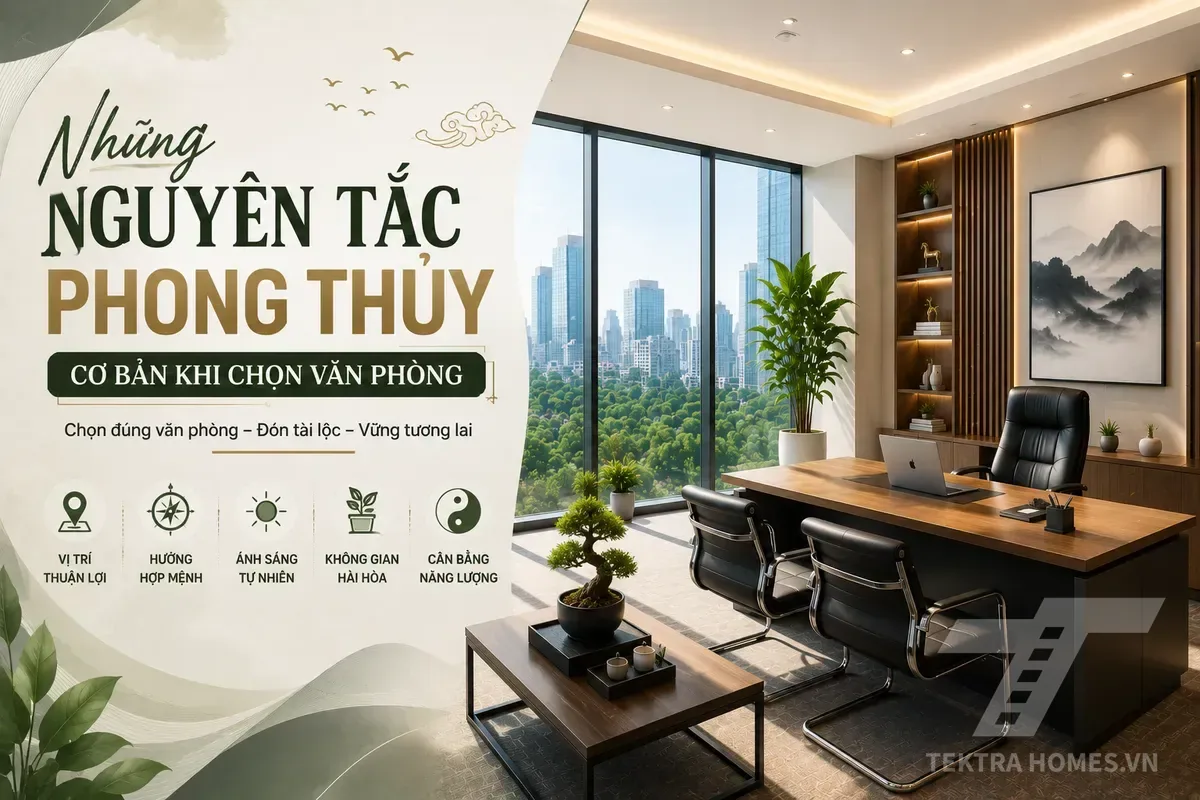
Essential feng shui principles for choosing an office to attract prosperity and success
In East Asian business philosophy, choosing a location for an office headquarters is not solely a matter of transport accessibility or rental costs; it is also strongly influenced by geographical feng shui. Modern feng shui is essentially the study of how landscape, microclimate, wind direction, natural light, and spatial magnetic fields interact with human psychology, health, and work performance.
An office space in a favorable location, with a harmonious flow of energy (Qi), can provide a solid foundation for leaders to make sound decisions, strengthen internal unity, and attract prosperity and good fortune for the business as a whole. Below are the fundamental feng shui principles every business owner should understand before deciding to lease a space.
The significance of feng shui in choosing an office headquarters
An office is the operational hub where intellectual resources converge and all of a company's commercial transactions take place. Applying feng shui principles appropriately can offer key benefits:
Activating prosperity and positive energy (accumulating Qi to generate wealth): Helps support stable cash flow, increase opportunities to secure high-value contracts, and reduce unexpected financial losses.
Improving employee health and morale: A well-ventilated workspace with sufficient natural light (Yang energy) can help employees reduce stress, maintain positive energy, and improve productivity.
Strengthening leadership position: Locating executive offices in stable, dignified positions can help leaders enhance their strategic vision and build trust with partners.
Assessing the location and site conditions of an office building
The surrounding landscape and site conditions of an office building are external feng shui factors that can have a direct and lasting influence on a business's growth and stability:
“Backed by mountains, facing water” and an “open Bright Hall”:
Ideally, the building should have a spacious, level frontage (the Bright Hall) with an unobstructed view.
There may be a naturally winding river or lake in front, or major intersecting roads that create a “flowing water gathering wealth” formation.
Other high-rise buildings at the rear can provide a stable backing (Rear Support), creating conditions for steady development.
Identifying and avoiding external “negative energy” formations:
Road Arrow: Avoid buildings where a major road points directly at the main entrance, as this is believed to lead to financial leakage and internal conflict.
Heavenly Blade Sha: A building positioned opposite the narrow gap between two closely adjoining high-rises, creating strong swirling winds and an unfavorable energy field cutting across the property.
Conflict Sha / Sharp Corner Sha: Office windows or the main entrance directly face sharp corners of opposing structures, broadcasting antenna towers, or high-voltage transformer stations.
Curved Bow Sha: A building located on the outside of a curved road or flyover, with the curve pointing toward the property.
Choosing an office orientation compatible with the owner's destiny and receptive to positive energy
Office orientation is the gateway for receiving natural energy and influences how well the workspace aligns with the company's legal representative:
Determining orientation using the East and West Life Groups:
Business owners in the East Life Group (Zhen, Xun, Li, Kan trigrams): Are suited to office orientations facing East, Southeast, South, and North.
Business owners in the West Life Group (Qian, Kun, Gen, Dui trigrams): Are suited to office orientations facing West, Northwest, Southwest, and Northeast.
Determining an office tower's energy-receiving direction:
For an independent commercial townhouse or shophouse: Office orientation is determined by the direction of the main front entrance.
For office floors in a high-rise building: Office orientation is determined by a balanced combination of the building's main lobby direction and the direction receiving the most natural light (the balcony direction or the main glass façade overlooking an open view).
Maintaining a Yin-Yang balance of light: Office spaces should prioritize abundant natural light while avoiding harsh direct sunlight (excessive Yang light). Conversely, offices that are too dark and poorly ventilated may accumulate Yin energy, creating a sense of fatigue and stagnation among employees.
Architectural form and office floor-plan structure
The shape of a leased floor plate reflects the balance and flow of energy within the company:
Square or rectangular floor plans (Earth and Metal elements): These are considered the most ideal structures in commercial feng shui. Regularly shaped floor plans symbolize stability and integrity, helping the energy field distribute evenly across all departments.
Avoid floor plans with major missing corners or irregular polygonal shapes:
L-shaped floors with sharp angles, triangular floors (Fire-related Sha), or floors with numerous sharp corners often create dead zones where stagnant energy accumulates, potentially causing discord between departments.
How to address this: If leasing such a space is unavoidable, use gypsum-board partitions, filing cabinets, or large plants to square off the main work area.
Considerations for ceilings and structural beams (overhead beam pressure):
Do not place executive or employee desks directly beneath exposed large concrete beams, which may create psychological pressure and reduce creativity.
The clear ceiling height should ideally be at least $2.7\text{m}$ to create an open, unconstrained atmosphere.
Feng shui principles for interior space planning
Arranging departments according to feng shui functions can help Qi flow smoothly and strengthen the management structure:
Location of the leadership office (CEO / Chairperson)
“Backed by mountains, overlooking the sea” position: The leadership office should be located in the most stable area of the company, often in the innermost corner behind other departments.
A stable seating position: The leader's back should rest against a solid wall (symbolizing support from benefactors), facing toward the door without directly confronting it, with a view across the entire workspace.
Avoid these taboos: Do not sit with your back to a window, beneath an overhead beam, or with the desk directly facing a restroom door.
Main entrance and reception area (Bright Hall for gathering Qi)
The main entrance (Qi gateway) should always be clear, clean, and well lit to welcome prosperity into the company.
Avoid a “Piercing Heart Sha” layout, where the main entrance aligns directly in a straight line with a rear door or large balcony door, as wealth is believed to flow out as quickly as it enters. A screen, reception desk, or branded logo partition can be used to gently redirect the flow of Qi.
Accounting and finance department location (wealth-gathering corner)
The financial management area should be located in the Wealth Position, typically the diagonal corner opposite the office's main entrance.
The accounting area should be private and quiet, away from heavy foot traffic, with the safe backed against a solid wall to help safeguard company funds.
Greenery and balanced Five Elements
Decorate with feng shui plants believed to attract wealth and purify the air, such as money trees, ZZ plants, Dracaena, Chinese evergreens, and snake plants.
Create a mutually supportive Five Elements ecosystem: brand-logo colors, wooden desks and chairs (Wood), aquariums or feng shui water features (Water), and lighting systems (Fire) can bring vitality and encourage creative work energy.
Summary table of common feng shui issues and practical remedies
Feng shui issue | Potential negative effect | Practical remedy |
Main entrance facing an elevator door | The energy field is continually disrupted, while noise can affect concentration. | Place a partition or reception desk in between, hang a neat curtain, or use a broad-leafed potted plant. |
Desk positioned with its back to a window | Lack of support (no rear backing), which may create feelings of unease and isolation. | Install thick light-blocking curtains or place a row of low filing cabinets behind the desk. |
Overhead beam above a desk | Psychological pressure, headaches, and reduced productivity. | Install a gypsum-board ceiling to conceal the beam or move the desk to one side. |
Floor plan with a major missing corner | Insufficient energy in the corresponding directional areas of the life destiny. | Install a flat mirror to visually extend the corner, or place a feng shui plant in the missing area. |
Office door facing a restroom | Stagnant air may flow directly into the space and adversely affect health. | Keep the restroom door closed, use an automatic deodorizer, and add a partition or screen. |