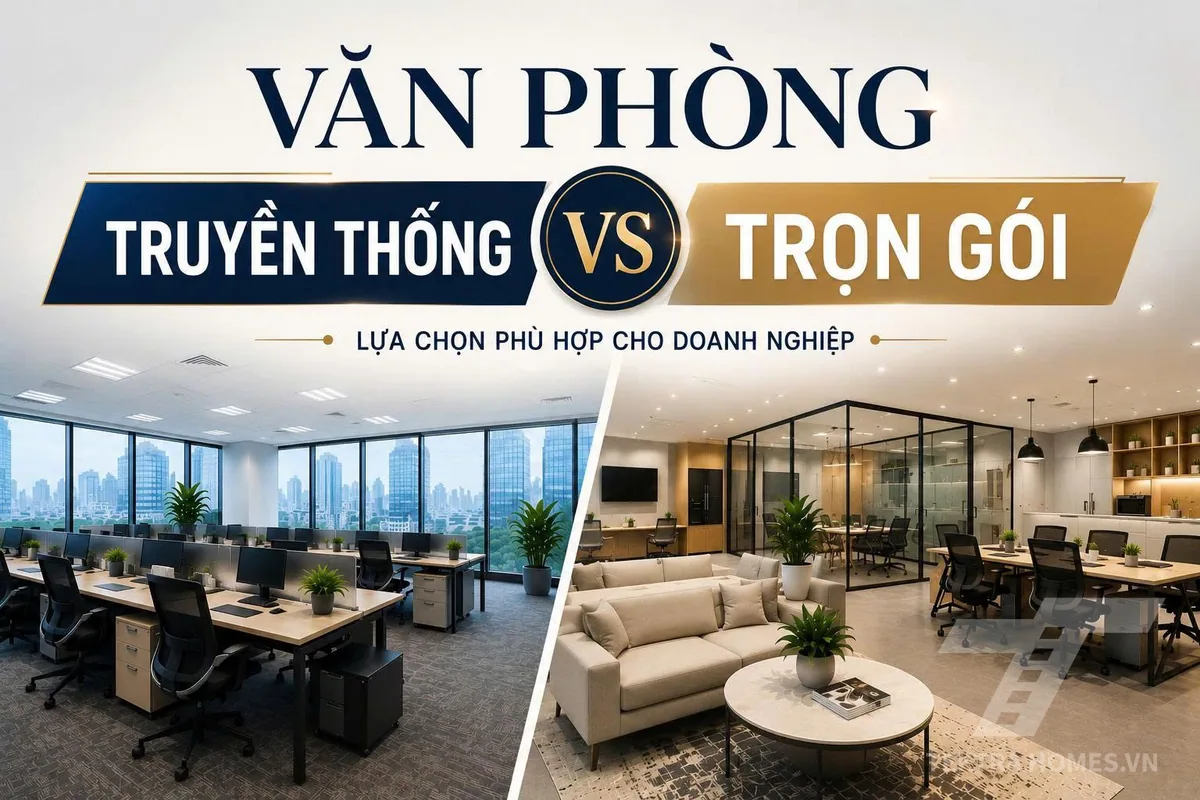
Traditional Offices vs. Serviced Offices: Which Is the Right Choice for Your Business?
When looking for a workplace, many businesses are often undecided between traditional offices and serviced offices. Each model has its own advantages and is suited to different business sizes, budgets, and growth objectives.
While traditional offices offer greater control over design and brand image, serviced offices stand out for their convenience, time savings, and ability to be operational immediately after the contract is signed.
So, which option is most suitable for your business? Explore the details with TektraHomes.
What Is a Traditional Office?
A traditional office is a model in which a business leases a private area in an office building and independently invests in all furnishings, equipment, and workplace operations.
The business is responsible for everything from design, fit-out, and purchasing desks and chairs to network systems, electricity, air conditioning, and office management throughout the lease term.
This is a common model for medium-sized and large businesses, or those with long-term development plans.
What Is a Serviced Office?
A serviced office is an office model that comes fully equipped with furniture and amenities. Businesses only need to bring their computers and staff to start working immediately.
Serviced offices typically include:
Work desks and chairs.
Meeting rooms.
Reception area.
High-speed internet.
Electricity and water.
Cleaning services.
Pantry area.
Printers and other office amenities.
This option is often preferred by startups, small businesses, and representative offices.
Comparing Traditional Offices and Serviced Offices
Criteria Traditional Office Serviced Office Initial investment cost High Low Time to become operational 1–3 months Can be used immediately Workspace design Full control Based on an existing design Operating costs Paid by the business Many amenities included Flexibility Low High Lease term Typically 3–5 years Flexible by month or year Scalability Additional space must be leased Easy to increase or reduce the number of seats
Advantages of Traditional Offices
Control Over Brand Image
Businesses can design the space according to their own brand identity, from colours and logos to furniture layout.
This helps create a professional impression with clients and partners.
Private Space
The entire office is for the business's use, helping ensure confidentiality and making management more convenient.
Suitable for Long-Term Growth
If a business plans to operate steadily for many years, a traditional office can offer long-term value.
Limitations of Traditional Offices
High initial investment costs.
Longer fit-out period.
Operations must be managed independently.
It can be difficult to change scale in the short term.
Advantages of Serviced Offices
Time Savings
Businesses can start working immediately after signing the contract without investing in furniture or fit-out works.
Cost Optimisation
Rental costs often include:
Electricity.
Internet.
Reception services.
Meeting rooms.
Cleaning.
Maintenance.
This helps businesses manage their budgets more easily.
Flexible Expansion
When staffing levels change, businesses only need to adjust the number of seats rather than relocate to another office.
Professional Working Environment
Serviced offices are often located in modern buildings, with reception areas, meeting rooms, and a range of premium amenities.
Limitations of Serviced Offices
It can be difficult to customise the design as desired.
The space is standardised.
The per-seat cost may be higher for larger businesses.
Some amenities are shared with other businesses.
Which Businesses Should Choose Traditional Offices?
Traditional offices are suitable for:
Businesses with 20–30 employees or more.
Companies that need to build a distinct brand image.
Businesses with information confidentiality requirements.
Companies planning to lease for the long term.
Corporations and foreign businesses.
Which Businesses Should Choose Serviced Offices?
Serviced offices are an ideal choice for:
Startups.
Newly established businesses.
Representative offices.
Companies with fewer than 20 employees.
Businesses that need to become operational immediately.
Companies looking to optimise initial investment costs.
Should You Lease a Traditional Office or a Serviced Office?
No single model is best for every business. The decision should be based on actual needs, budget, and growth strategy.
If your business needs a stable workspace that can be independently designed and used over the long term, a traditional office may be the suitable choice.
Conversely, if you want to save time, reduce initial investment costs, and start operations quickly, a serviced office may be the optimal solution.