
Common mistakes businesses make when renting an office and how to avoid them
Searching for and signing an office lease is one of the most important financial decisions, directly affecting fixed cash flow, work efficiency, and brand image for every business over a period of 3 to 5 years. However, the commercial real estate market is highly specialized, with numerous technical terms, complex fee structures, and strict legal requirements.
Many businesses—from startups and small and medium-sized enterprises (SMEs) to expanding corporations—often make serious mistakes during site inspections, cost calculations, and contract negotiations. Below is a detailed analysis of typical mistakes, together with practical solutions to help managers protect their interests and optimize their budgets.
Confusing gross leased area with net usable area
One of the most costly mistakes businesses make is failing to clarify the measurement method when receiving a quotation:
The nature of Gross and Net areas:
Net Area (usable area): The actual area within the office that the business may fully arrange with furniture and use (usually measured from the centerline of partition walls or the inner face of perimeter walls, excluding structural columns and large service shafts).
Gross Area: Includes the Net area plus an allocated share of common areas in the building, such as floor corridors, elevator lobbies, shared restrooms, and technical rooms.
Loss Factor: In many buildings, the difference between Gross and Net area ranges from 10% to 25%. If a business signs a lease charged on a Gross area of 500 m2 at a rate of USD 20/m2/month, the actual usable area may be only around 400 m2, meaning the business pays an additional USD 2,000 each month for space where workstations cannot be placed.
Overlooking hidden operating costs and additional charges
Many managers focus only on negotiating the base rent while overlooking the Total All-in Cost, causing actual expenditure to exceed the initial budget by 30% to 50%:
Building service charge: Ranges from USD 3–8/m2/month. It is necessary to clearly determine whether this fee includes air-conditioning electricity during business hours.
After-hours air-conditioning fee (Overtime Fee): Buildings using central air-conditioning systems (Chiller/VRV) commonly charge USD 15–35/hour/floor (or charge based on air-conditioning capacity). For businesses in IT, technology, or import-export that frequently work evening or weekend shifts, overtime costs can reach tens of millions of Vietnamese dong per month without a separate agreement from the outset.
Motorbike and car parking quotas and rates: Many buildings in central areas have limited basement space and provide only a set number of parking spaces. Vehicles exceeding the quota must use nearby parking facilities, which can be costly and inconvenient for employees.
Actual electricity bills: Check whether the electricity rate follows the government business electricity tariff or a separate building tariff with additional technical surcharges.
Misjudging workforce size and contract flexibility
Poor space planning leads to two common risk scenarios:
Leasing too much space due to overly rapid growth expectations: The business bears an excessive burden of occupancy and electricity costs while revenue has not met expectations, reducing reserve cash flow.
Leasing space that exactly fits the current headcount: When departments expand or new employees are hired after one year, the office becomes overcrowded and cramped, reducing productivity, while no additional floor space may be available in the same building.
A contract without expansion/contraction provisions: Commercial lease terms typically run for at least 3 years. Without provisions allowing priority rights to lease adjacent space or the right to sublease, the business may forfeit its entire security deposit if it must terminate the lease early to relocate.
Overlooking building legality and fire prevention and fighting standards
Legal compliance and building safety are critical factors, yet they are often underestimated during the initial inspection:
Fire prevention and fighting (PCCC) acceptance requirements: Under current regulations, office buildings and newly fitted-out premises must have a fire prevention and fighting acceptance record issued by the competent authority. Leasing space in buildings that have not completed fire safety acceptance may result in business suspension, inability to obtain approval for fit-out designs, or administrative penalties.
Permitted land use and business registration: Leasing offices in unauthorized construction, private houses located in areas designated for clearance, or standard residential apartments (without commercial/Officetel functions) may result in tax authorities refusing to issue a tax identification number or not permitting registration of the company’s registered office address.
Insufficiently clear reinstatement and construction-period terms
The beginning and end of a lease are periods when financial disputes often arise if terms are not clearly defined:
Rent-free fit-out period: Many businesses negotiate only 15–30 days of fit-out time for a large floor area. When fire safety construction permits or material imports are delayed, construction may extend into the official rent-charging period, creating duplicate costs.
Make-good Clause: At the end of the lease, the building owner often requires the tenant to remove all glass partitions, gypsum ceilings, carpets, network cabling, and restore the floor to the original smooth concrete condition at handover. Demolition, debris removal, and reinstatement can cost from tens to hundreds of millions of Vietnamese dong unless an agreement permits high-value items to remain.
Summary of common mistakes and preventive solutions
Common mistake | Financial & operational impact | Best preventive solution |
Not measuring the actual Net area | Paying for 10%–25% of unusable space | Request a floor plan marking the Net area as an attachment to the lease; measure the space in person before handover. |
Overlooking after-hours (OT) costs | Monthly operating costs rise sharply due to overtime shifts | Negotiate for independently operated local air-conditioning or cap OT fees based on usable square meters. |
Signing an overly long, inflexible contract | Loss of the security deposit when scale must change before the term ends | Negotiate an option to lease additional floor space (Expansion Option) or limit early termination penalties. |
Not checking the fire safety acceptance record | Risk of business suspension and delayed opening | Require the building owner to provide the overall fire safety acceptance documentation before signing the lease and paying the deposit. |
Strict reinstatement obligations | High removal and reinstatement costs upon moving out | Agree on a list of fixed fit-out items that may remain if the next tenant wishes to take them over. |
Risk-control process for businesses renting an office
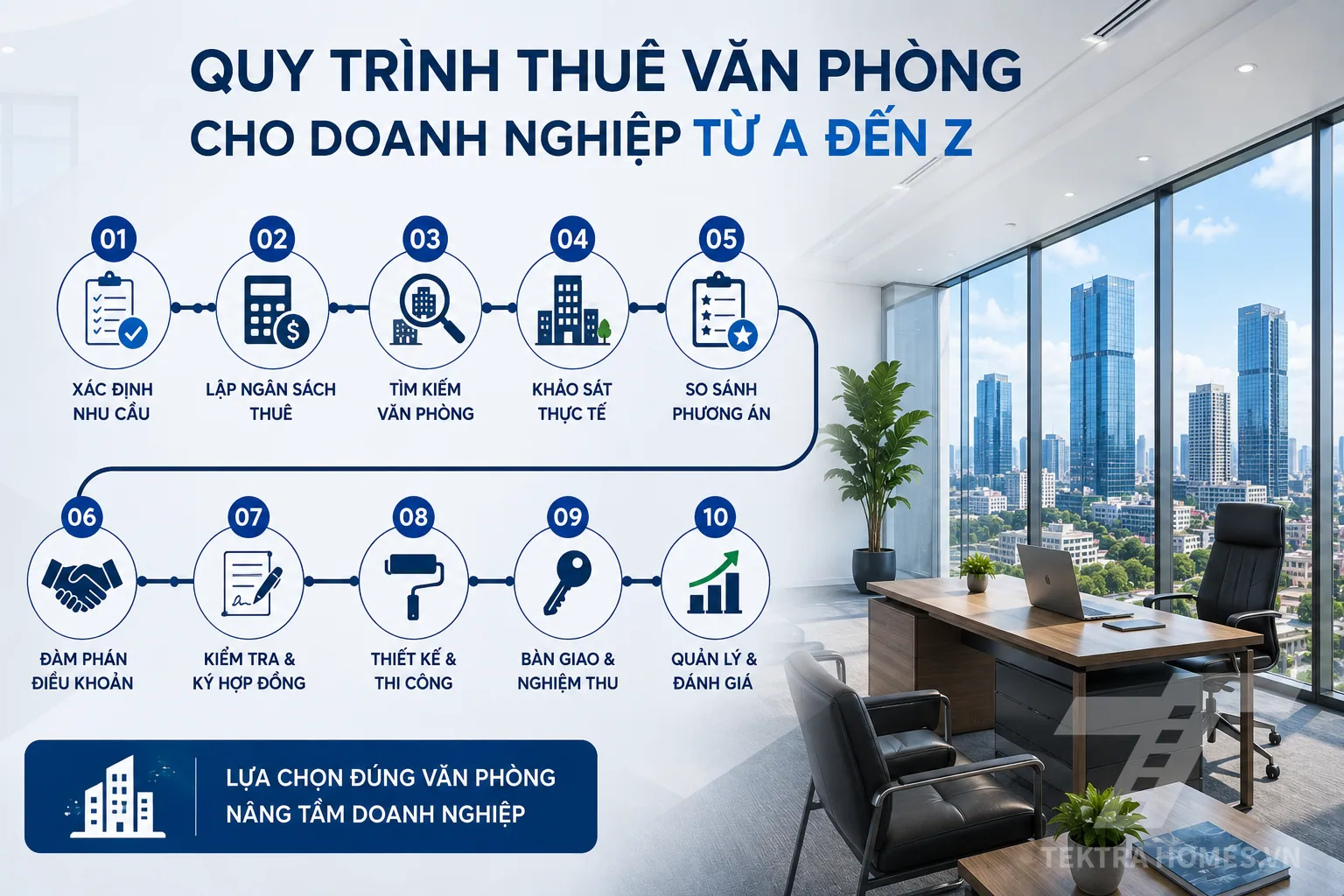
To ensure a smooth and secure search and contracting process, businesses should apply this standardized four-step process:
Step 1 – Prepare a requirements brief and All-in cost estimate: Determine the required Net area, parking allocation, after-hours working needs, and prepare an overall budget (rent + service charge + utilities + VAT + parking).
Step 2 – Conduct a comprehensive on-site inspection: Directly assess elevator quality, ceiling clearance, natural light orientation, backup generator capacity, and fire safety infrastructure.
Step 3 – Submit an Offer Letter / LOI: Agree on all key commercial terms (rate, fit-out period, after-hours fees, periodic escalation rate) before drafting the formal contract.
Step 4 – Conduct an independent legal review of the contract: Verify the building owner’s legal status, compare the condition handover record, and review penalty clauses to ensure a balanced allocation of rights and interests between both parties.